01This is not a simple machine
CureWood Engineered Building Products makes finger-jointed lumber in Surrey, British Columbia. Ben McKinnon started the company to do something specific with cheap wood: “take smaller, low-value pieces of wood and turn them into more advanced, higher-value pieces of wood.”
The machine that does it is a GRECON FJ finger-jointing line commissioned in 1991, and it is a serious piece of equipment. A magazine conveyor stages packages of boards. Two cutter stations mill interlocking joint profiles, one for each end of the board, each with its own clamps, vibrating tables and feed drives, handing work across a transfer table between them. Glue goes on, feed rollers drive the boards end to end through a length-measuring system, a saw cuts the moving string at exactly 2.50 meters, and crossfeeds push the cut pieces into a hydraulic press. One controller choreographs all of it through 98 sensors, 91 outputs and 54 timers. When the line is running well, each cutter table cycles every 23 seconds and the press ejects a finished charge every couple of minutes.
That controller is a Siemens SIMATIC S5, programmed in May 1991 and last modified by hand in November 1994. Ben had to recover the original program from the machine builder in Germany. The rest of the documentation is paper: the ladder printout that shipped with the machine, part German and part English, and a wiring schematic he described as a full phone book, which he took to a Staples self-service scanner and emailed over in two parts. This is normal for how CureWood grew.
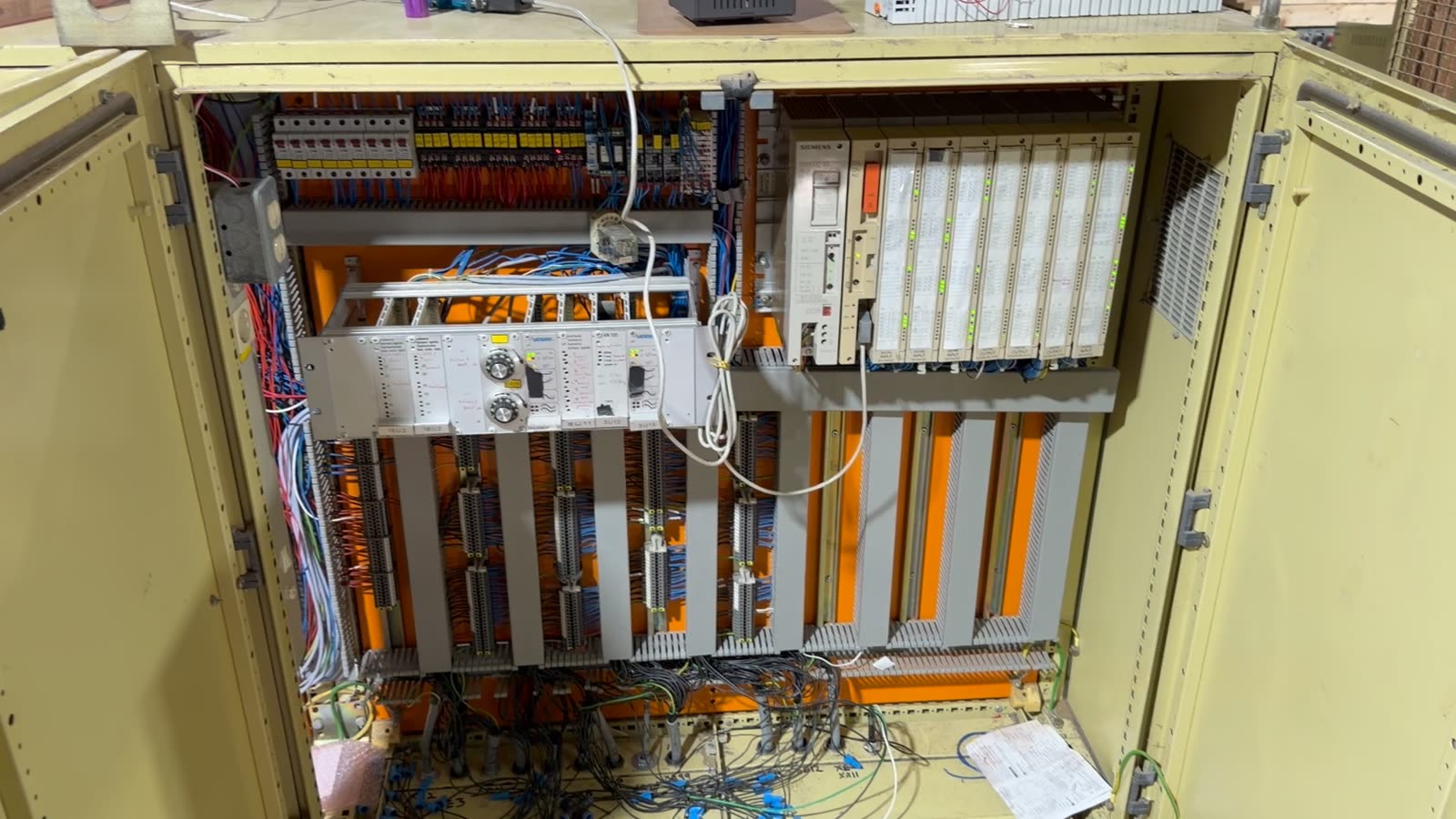
“We bootstrapped the whole operation, so a lot of the time it was driving to far-flung corners of the continent to go pick up old pieces of machinery that we could afford, bringing them back here and re-automating them without an instruction manual. You are working with PLCs from the 80s, you are making a lot of guesses about how sensors and things are supposed to all work together to function properly. It is really hard to troubleshoot. It is hard to have a view into what the machinery thinks is going on. And it is slow connecting to the machine.”
Every change to the line ran through that paper and a laptop plugged into the rack. The risk was not the work. It was what the work might cost him.
“I was always worried that if we made too many changes to our PLC from 1991, it might be the last change we ever made to it.”
02Nobody quotes a 30-year-old machine sight unseen
Before we priced our own work, we tried to get a market baseline. Our research suggests similar projects typically run $100k–$150k. We worked with Ben on pulling competing quotes, and what he said is the reason this genre of project stalls for years:
“As much as I would like them to just fire back itemized quotes for a machine that is 30 years old, site unseen, that is just not going to happen.”
We believe in price transparency. We built the quote bottom-up from fundamentals, and we charged him:
- $2,950 for the Cortex AIC
- $3,000 in third-party I/O hardware
- $4,000 for integration hours and to cover our international travel
03Step one was reading a program nothing modern can open
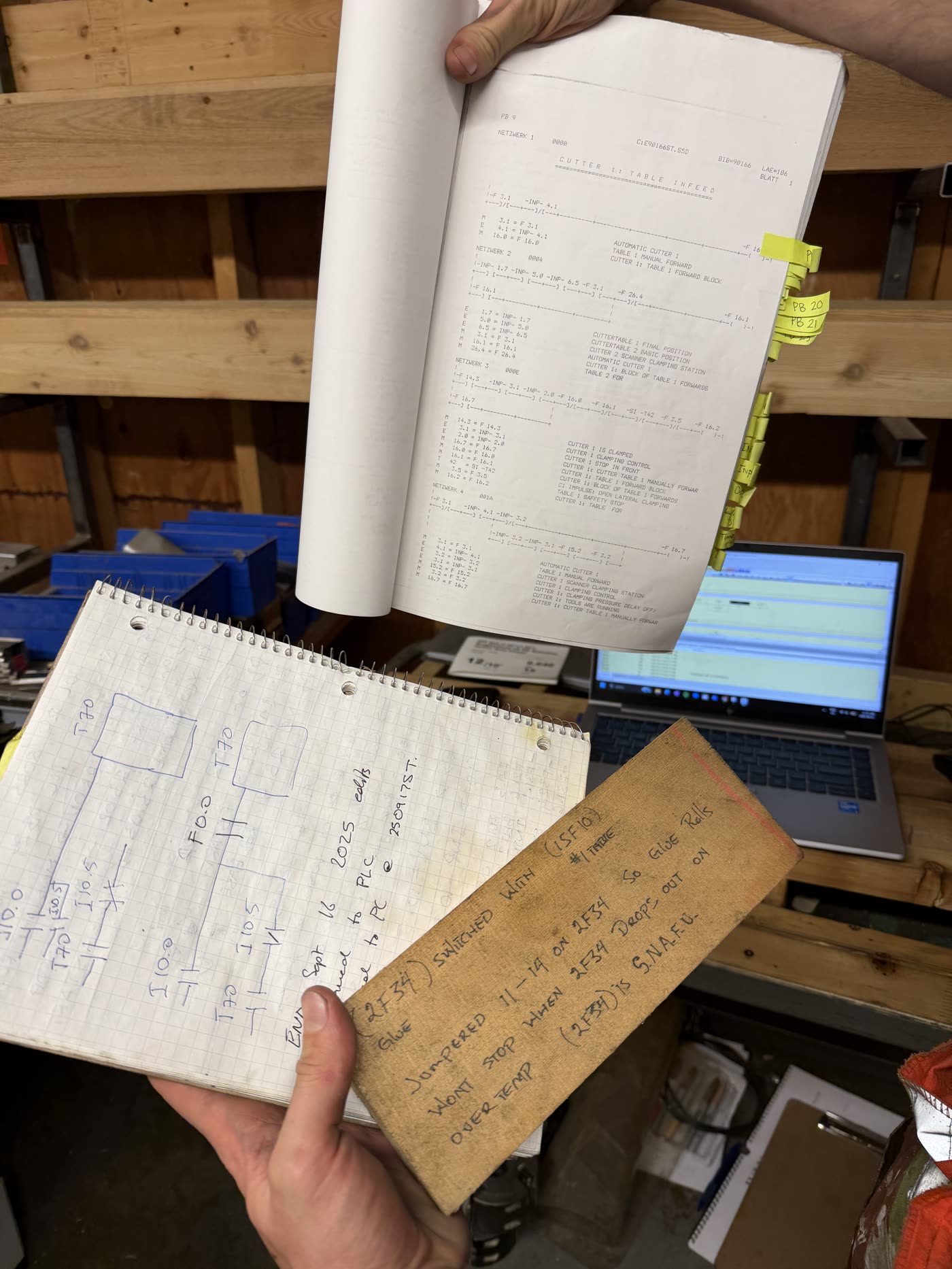
The S5's program lived in two places: on that paper, and as MC5 machine code inside the rack. We scanned every page and put twelve agents on transcribing them in parallel, with one hard rule: flag anything smudged or ambiguous instead of guessing. Then we decoded the machine code itself, 2,420 instruction words across 22 blocks, with a decoder we could prove correct two ways. Re-assembling our decode reproduced all 2,420 statements exactly, and an independent open-source Step5 tool read 31 of 32 blocks the same way we did.
Good thing we did both, because the paper is wrong in places. Simulation turned up five printed contact readings the machine physically could not run under, and all five were spots the transcribers had flagged.
Then Ben sent us the program actually running in his rack, with a note that it was the 1991 program “with our small little edits.” Those edits mattered. The running program differed from every document we had in 15 places, including six timer presets somebody had retuned over thirty years and never written down. We built to the machine, not to the paperwork.
04We proved the port before we touched the machine
We translated the program, network by network, into real-time Python on our controller, the Cortex AIC. We also built a behavior simulation of the whole line into an FMU model: the magazine, both cutters, the transfer, the saw, the press. Then we ran the ported program against it until the simulated line made lumber the same way the real one does.
Then came the real test. We checked our port against the program running in the rack, statement by statement, all 300 of them. Zero differences. That is the whole basis for what we told Ben in writing, three days before we flew: the schematics had anchored the simulation model, and we felt really confident about one-shot success of the retrofit. Every retrofit promises the new system will behave exactly like the old one. We were willing to put it in an email first.
05What the calendar actually looked like
“We got in touch with each other less than a week ago. Within 24 hours of that, we had simulation models in the works. We sent them old PDF copies of ladder logic. They converted that to more modern simulations. And then within three days, they were up in our facility. And within 24 hours of that, we had our old systems replaced with their technology.”
06The cutover took one shift
We arrived on site, Cortex in hand, with the new EtherCAT I/O terminal. 189 wires, one 8-hour shift from lockout to power-up, and most of that was screwdriver time.
Two things we deliberately did not touch. The hardwired safety chain of e-stops, guard circuits and motor starters was never part of the PLC program and stayed exactly as it was. And the S5 rack came out intact. Every wire lands back where it came from, so the old controller is still a physical rollback path. CureWood runs on our stack now, and supporting it is our job.
07Then we turned it on
The hydraulics came up. Ben went through the machine the way an owner does. He cycled every operator console. He jogged every moving component by hand. Then he ran real boards through end to end: out of the magazine, profiles milled at both stations, glue on, the saw cut, a pressed charge out the back. He checked the finished product and went feature by feature, looking for anything that behaved differently. After thirty minutes he ran out of things to check.
One shot, exactly as we called in the email.
“I honestly feel like we just went from being in 1991 to being in 2026 over the course of like four days. And this never even made it on my to-do list of things we were going to do this week. It just happened.”
08What the line gained
The logic is unchanged on purpose. Everything around it moved 35 years forward. Right after power-up we built new HMI panes that Ben can draw and maintain by himself. The line now has a historian recording every one of the 189 points, remote access, and a program a human can actually read. Neuron's AI agent is now also live with CureWood, able to answer troubleshooting questions based on data and build new logic in plain English.
The historian went to work immediately on the faults that used to be unfindable.
“We had a few issues in the machine that we had a hard time troubleshooting. They only came up so often, and when they did come up it was a problem, but they would come and go so quickly it was really hard to track down the reasons why. Now we have a good timestamp and good traceability of all the intricacies of this machine operating throughout its service life, where we can go back in time and see what happened on this day, what the problem was, what the solution will be.”
It proved itself during commissioning on exactly that kind of fault: a photoelectric sensor that confirms one of the moving carriages is in position started reading marginal. The trace showed it right away, and the diagnosis took minutes. Dust on the lens. One wipe and the signal came back. On the S5, that would have been an afternoon of wire wiggling.
“As someone who inherited this project and has no formal training in automation or controls, having to learn ladder logic to be able to communicate with this machine has been a big challenge for our business over the course of the last few years. Once we got this box installed, I am at a point where I can have a conversation interface with this brain, tell it we are having a problem with cutter number two on our machine, and it is going to come back and say okay, try this, this and this. We are going to be able to troubleshoot that problem in a way that I am able to communicate with another human, essentially.”
09This is only the beginning
Three days after the line was running, we sent Ben a proposal for two instrumentation clusters, each in a small cabinet near the sensors it serves: one by cutter 2 and the glue dispense, one at the end of the line. Coupler, analog input card, digital in and out, a string potentiometer for position, and a camera for the glue work. He approved it the same morning.
Those two clusters are the upgrades he had wanted for years and could not have on the S5. The first adds carriage position feedback and patterned glue dispensing on the finger joints, so the press cannot over-squeeze a joint. The second retires the most hated part on the machine, the length encoder: today a wheel rides along the wood, glue keeps fouling it, and it dies regularly. A string pot on the staging-table backstop measures the same thing without ever touching the product. He is already sending us photos to train the glue-inspection model, and offering to build the camera mount and lighting himself.
“I am also really excited about the opportunity to build different GUI interfaces for our employees. There have always been things like that we wanted to implement, but the amount of time and energy it would take to connect this to our old automation system was tricky. Now, having the opportunity to make these iterations quickly, and even when you put something in place to be able to reiterate again and make sure you get it to the point where it needs to be to be in production.”
“As someone who has operated this piece of equipment for a few years, the things that you bang your head against the wall on that seem unsolvable, we now have the tools to solve them. I am very confident of that.”
If you have a machine running on a controller nobody supports anymore, hit us up.